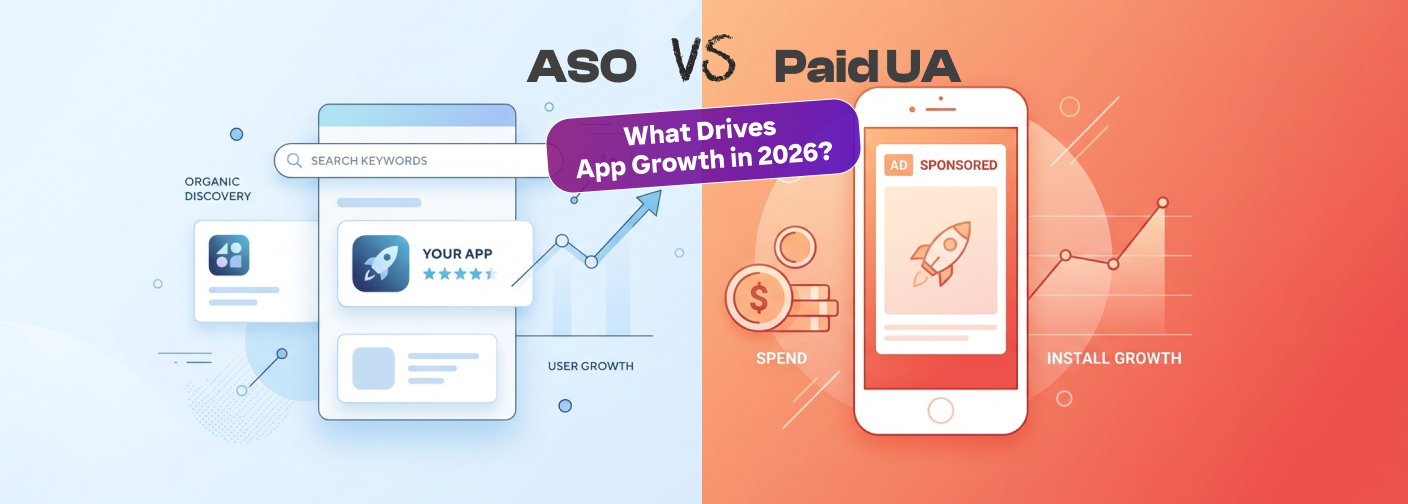

ASO vs. Paid UA: What Works Better in 2026
If you are growing a mobile app, at some point you will face this question: invest in App Store Optimization, or put budget into paid user acquisition?
The honest answer is that framing it as a choice is usually a mistake. But you can only reach that conclusion once you understand what each channel actually does and where each one creates leverage for your specific product.
At Mobihunter, user acquisition is our core service. We run UA campaigns for mobile-first businesses across Meta, Google, TikTok, and Apple Search Ads, and we work alongside ASO strategy on most of our accounts. We have seen what happens when teams over-rotate into paid and burn budget on users who do not stick. We have also seen what happens when teams rely entirely on organic and miss the growth window when their product had momentum.
This article is what we actually tell clients when they ask us to help them make this decision.
What ASO and Paid UA Actually Do
App Store Optimization (ASO)
ASO improves how your app appears and converts in the App Store and Google Play. It covers two main areas:
- On-metadata optimization: title, subtitle, keyword fields, description, and categories. This determines which search queries your app appears for.
- Conversion rate optimization: icon, screenshots, preview video, ratings, and review strategy. This determines how many of those searchers actually install.
ASO is effectively SEO for app stores. It is a compounding, long-term channel. Well-optimized metadata keeps working without ongoing spend. But it requires patience. Meaningful ranking shifts typically take weeks or months, not days.
Paid User Acquisition (Paid UA)
Paid UA is the umbrella term for buying installs and in-app events through advertising platforms. In 2026, the major channels are:
- Meta Ads (Facebook and Instagram): still the dominant channel for most consumer app verticals due to audience depth and algorithm maturity
- Google UAC: strong for Android-first apps and categories with high search intent
- Apple Search Ads: captures high-intent users already searching in the App Store, strong fit for iOS-first products
- TikTok Ads: increasingly important for consumer apps targeting younger demographics, particularly in gaming and social categories
- Programmatic networks (IronSource, AppLovin, Unity Ads): primarily used for gaming and utility apps
Paid UA delivers results immediately. You can launch a campaign today and have installs tomorrow. The tradeoff is that the moment you stop spending, growth stops.
At Mobihunter, paid UA is what we do every day. Our team manages campaigns across all of these channels and understands how the algorithms, auction dynamics, and attribution mechanics work in each one. That depth matters when you are trying to spend efficiently at scale.
The Core Tradeoff: Speed vs. Compounding
This is the fundamental difference between the two channels.
Paid UA is a tap. Turn it on, get results. Turn it off, results stop. The economics depend entirely on whether your LTV exceeds your CPI. In most verticals, that margin is tighter than it looks once you account for attribution noise, creative fatigue, and platform volatility.
ASO is a foundation. It takes longer to build, but once it is working, it generates installs continuously without incremental spend. A well-ranked app with a high-converting store page compounds over time as your rating and review volume grows.
The mistake most teams make is treating these channels as interchangeable. They are not. They solve different problems and should be evaluated on different timelines.
When ASO Creates the Most Leverage
Early-stage apps with limited budgets
Paid UA requires significant spend to generate enough data for algorithm optimization. If you cannot sustain at least $5,000 to $10,000 per month per platform consistently, you will not get the learning cycles needed to make campaigns efficient. ASO has a better effort-to-cost ratio at early stages.
Apps in categories with strong search behavior
Tools, utilities, finance, health, and productivity apps are often searched for directly in app stores. Users know what they want and go looking for it. Strong keyword rankings in these categories can drive substantial organic installs at near-zero marginal cost.
Improving paid UA efficiency
This is something teams frequently underestimate: ASO directly affects the performance of paid campaigns. On Apple Search Ads, your metadata determines which search terms you can bid on. On all platforms, your store page conversion rate affects your effective CPI. An app that converts 40% of paid traffic versus 25% is paying 40% less per install for the same ad spend.
At Mobihunter, when we take over a paid UA account, one of the first things we look at is the store page conversion rate. Fixing ASO before scaling paid often has a bigger impact on CPI than any campaign optimization we can run.
Apps with high organic intent signals
If your app already has a recognized brand or product name that people search for, optimizing for branded terms captures demand that already exists. It costs nothing and converts at a high rate.
When Paid UA Creates the Most Leverage
Fast feedback loops in a new market
Paid campaigns generate data quickly. If you need to validate whether a market responds to your product, paid UA is the fastest way to get statistically meaningful signal without waiting months for organic rankings to develop.
Scaling proven unit economics
When your CPI, retention, and LTV are well understood and the numbers work, paid UA scales linearly. Doubling budget, when done carefully without disrupting algorithm learning, can double installs. ASO does not scale that directly.
This is what scaling looks like at Mobihunter. We do not just increase budgets. We expand placements and structures that have demonstrated consistent efficiency. Disciplined scaling is what keeps unit economics intact at higher spend levels.
Competitive categories with saturated organic rankings
In categories like gaming, dating, or ride-sharing, the top organic positions are held by apps with massive rating volume and brand recognition. Breaking into those rankings can take years. Paid UA buys visibility regardless of your organic authority.
Re-engagement and retargeting
Paid UA is the only channel for reaching lapsed users. If you have a large existing user base with inactive cohorts, retargeting campaigns, properly segmented by behavior and recency, can reactivate users at a fraction of the cost of new acquisition.
What Has Changed in 2026
Platform automation has reduced targeting leverage
Manual targeting in Meta and Google campaigns has been largely replaced by broad audience strategies and algorithmic optimization. The lever has shifted from audience selection to creative quality and signal quality. Teams that were winning on targeting expertise alone have lost their edge. The ones winning now are investing in creative infrastructure.
Privacy changes have made attribution harder
SKAdNetwork on iOS and the gradual rollout of Google's Privacy Sandbox have reduced the granularity of install attribution. Multi-touch attribution is more difficult. This increases the value of first-party data, which is primarily generated through organic and owned channels, not paid.
ASO has grown more sophisticated
Apple and Google have expanded the ASO surface area significantly. Custom product pages on iOS, store listing experiments on Android, and richer metadata fields all create new opportunities. Teams that run systematic creative testing in the store, not just keyword optimization, are seeing meaningfully better conversion rates.
Creative is now the primary differentiator in paid UA
With targeting automated, creative is the biggest lever available to paid UA teams. The best-performing campaigns in 2026 are built on rapid, structured creative testing: high volume of variants, controlled hypotheses, and tight feedback loops from MMP data back into creative briefs.
At Mobihunter, creative testing is not a side activity. It is a core part of how our UA team operates. We build hypotheses based on real funnel data, test systematically, and scale what works. That process is what drives performance improvement over time, not just media buying.
How to Combine ASO and Paid UA Effectively
The strongest mobile growth programs treat ASO and paid UA as complementary, not competing.
- Start with ASO as infrastructure. Before scaling paid UA, ensure your store page converts well. If you are spending $10,000 per month on ads driving traffic to a store page that converts at 15%, fixing ASO to 30% conversion cuts your effective CPI in half.
- Use paid UA to accelerate ranking signals. App store algorithms factor in install velocity and user behavior. A paid campaign that drives high-quality installs with strong engagement signals can boost organic rankings, effectively using paid spend to compound organic performance.
- Optimize toward mid-funnel events, not just installs. Whether paid or organic, installs are a vanity metric. Define the event that predicts long-term value in your funnel, registration, first key action, first transaction, and measure both channels against it. This is what we do at Mobihunter. We identify the mid-funnel signal that best predicts downstream revenue and build our optimization strategy around it.
- Apply paid creative learnings to ASO. The visual assets that perform in paid ads, the hooks, value propositions, and use cases that stop the scroll, are strong signals for what will convert on your store page. At Mobihunter, creative insights from paid campaigns regularly feed directly into ASO creative updates.
- Track incrementality, not just attribution. Attribution models tell you what converted. They do not tell you what caused the conversion. Running holdout tests and incrementality experiments, even at small scale, is the only way to understand the true contribution of each channel.
A Framework for Making the Decision
Prioritize ASO if: you are early-stage with limited budget, your category has strong search intent, your store page conversion rate is below benchmark, or you need to improve the efficiency of existing paid spend.
Prioritize paid UA if: you have proven unit economics and need to scale, you are entering a new market quickly, your category is dominated by entrenched organic competitors, or you need to reactivate a lapsed user base.
In most cases, run both. Build ASO as the foundation. Use paid UA to accelerate. The teams that win in mobile growth are not choosing between these channels. They are building infrastructure that makes each one reinforce the other.
That is exactly how we structure growth programs at Mobihunter. If you are trying to figure out the right balance for your product, we are happy to walk you through it.