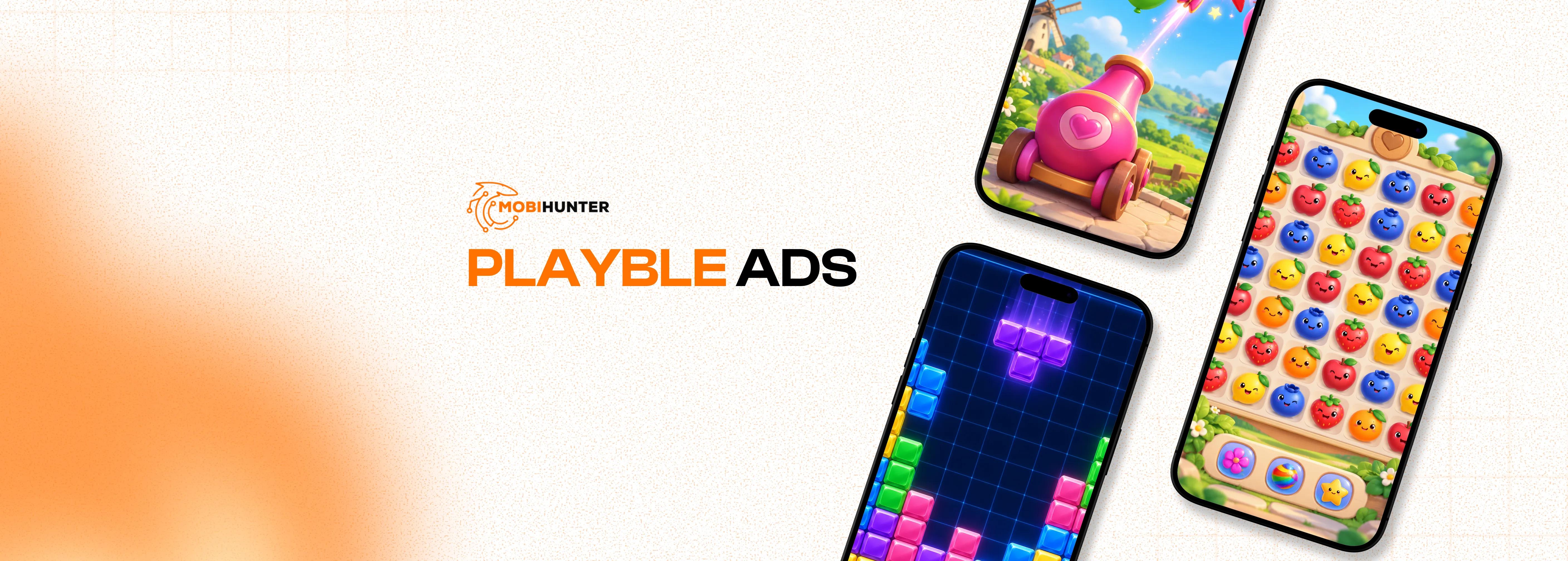

PLAYABLE ADS
What Are Playable Ads?
A playable ad is a short, interactive preview of an app or game that runs inside an ad placement. Instead of only watching a video or viewing a banner, the user can solve a puzzle, make a choice, or try a simplified version of the product before deciding whether to install it.
Unlike a static banner or video, a playable lets people interact with the product. By the time they reach the install button, they already understand part of the experience and can make a more informed decision.
The preview should stay close to the real product. If the mechanic shown in the ad has little in common with the app or game, it may attract installs from people who leave as soon as they discover the difference. A good playable is engaging, but it also sets an honest expectation. Read more about the format in Mobihunter's article on the shift from passive to interactive advertising.
Why Use Playable Ads for Mobile User Acquisition?
Playable ads can influence not only how many people install, but also who chooses to install.
Users interact with part of the product before downloading it, which can help attract people who are genuinely interested in the experience. Playables work best as part of a wider creative mix, alongside static and video ads, rather than as a replacement for every other format.
They can also support creative research. Testing different mechanics, hooks, and interaction flows shows what attracts attention and where users lose interest. These findings can inform future creatives and, in some cases, product decisions.
Results still depend on the concept, audience, channel, and testing setup. A playable does not guarantee a lower CPI or higher ROAS, but it gives UA teams a way to test an interactive product preview that static and video ads cannot provide.
When Does Your App or Game Need Playable Ads?
- Pre-launch or soft launch. Check whether a core mechanic interests the target audience before committing a larger UA budget.
- A new concept or mechanic. Test whether an idea holds attention before investing in wider development or promotion.
- A new GEO. Learn how a mechanic or hook performs with a different audience before scaling in that market.
- A new advertising channel. Requirements vary by network and placement, so playable creatives often need specific adaptations.
- Creative fatigue. If your existing static and video ads are losing traction, an interactive format gives the campaign a genuinely different concept to test.
- Campaign scaling. Turn a proven concept into an interactive experience and test it with a wider audience.
- Limited in-house capacity. Add playable production without hiring a separate interactive or HTML5 development team.
- A mismatch between the ad and the product. A playable based on the real experience can set clearer expectations before installation.
Mobihunter's Playable Ads Services
Mobihunter's Playable Ads Services
Our team can support the full production cycle:
- Product and competitor research. We study your product, audience, and the creative approaches used in your category before choosing a direction.
- Concept development. We prepare mechanics, hooks, and creative ideas based on the product and campaign goal.
- Scenario and interaction flow. We map the user's path from the first action to the install CTA.
- UX/UI and visual design in Figma. You can review and approve the interaction and visual direction before development begins.
- Playable development. We turn the approved design into a working HTML5 playable.
- Platform and placement adaptation. We prepare the asset for the technical requirements of the channels where it will run.
- QA and technical checks. We test the playable on relevant devices and operating systems before launch.
- Launch support and creative testing. We help run the initial test and compare the playable with other campaign creatives.
- Performance analysis. We review engagement and campaign data to understand how the playable performs.
- Iteration and optimization. We adjust the hook, mechanic, or flow based on test results.
How We Create Playable Ads
1. Performance analysis. We review engagement and campaign data to understand how the playable performs.
We review your product, audience, campaign goals, and available UA data. This gives the team a clear brief for the playable.
2. Competitor & creative research
We look at competitors and related products to understand which interactive approaches are already common and where there is room to stand out.
3. Selecting the mechanic, hook & concept
We look at competitors and related products to understand which interactive approaches are already common and where there is room to stand out.
4. Prototype & Figma design
We map the interaction and prepare the visual design in Figma for your review before development.
5. Development
We build the approved concept as an HTML5 playable and prepare it for technical testing.
6. QA & platform adaptation
We build the approved concept as an HTML5 playable and prepare it for technical testing.
7. Launch & testing
We support the first campaign test and monitor the early performance signals agreed at the start of the project.
8. Performance analysis & iteration
We review the results, identify where users engage or drop off, and recommend the next changes to test.
Why Choose Mobihunter?
Playable ads bring together two areas Mobihunter already works with: creative production and mobile user acquisition. This means the creative can be developed with campaign goals and testing requirements in mind from the start.
- When Mobihunter also manages the UA campaign, we can test the playable alongside other formats and review the results using the same campaign data.
- One team throughout the project. Strategists, designers, developers, and media buyers work together from the first concept through post-launch analysis.
- Experience across products and markets. Our team works with mobile games and apps in different niches and adapts creatives for different audiences and GEOs.
- Testing is part of the workflow. We use campaign data to decide what to adjust in the next version.
Playable Ads for Different Products
- Casual and puzzle games. A playable can often use a simplified version of an actual level, match, or puzzle, giving users a clear sense of the gameplay.
- Strategy and core games. The ad can focus on one meaningful decision, battle, or building action instead of trying to reproduce the full game.
- Multiplayer games. Because a live multiplayer session cannot be reproduced inside an ad, the playable can simulate a short moment that represents the core loop.
- Non-gaming apps. An interactive preview may take the form of a budgeting demo, product quiz, calculator, or simplified onboarding flow. The format can work whenever a short interaction explains the value of an app better than a screenshot.