
Web-to-App Funnels in 2026: How to Build, Track, and Scale
If you run paid user acquisition for a mobile app, you have probably noticed that the standard flow of "run ad, send user to the App Store, hope they install" is getting more expensive and less readable every quarter. CPIs are up 15 to 25 percent year over year. iOS attribution is still noisy. And you are spending a meaningful percentage of your budget on users who never make it through the store page.
Web-to-app funnels are not a new idea, but in 2026 they have crossed from "experimental tactic for well-funded teams" into standard practice for any subscription, fintech, or health app spending seriously on paid UA. AppsFlyer reported a 77 percent surge in web-to-app conversions in 2024, and that momentum has only continued into 2025 and 2026. If your team has not seriously evaluated this approach yet, this guide is a practical starting point.
We run web-to-app setups for a range of clients at Mobihunter, and what we have learned is that the mechanics are not complicated, but the details matter a lot. Here is how it actually works.
What a Web-to-App Funnel Actually Is
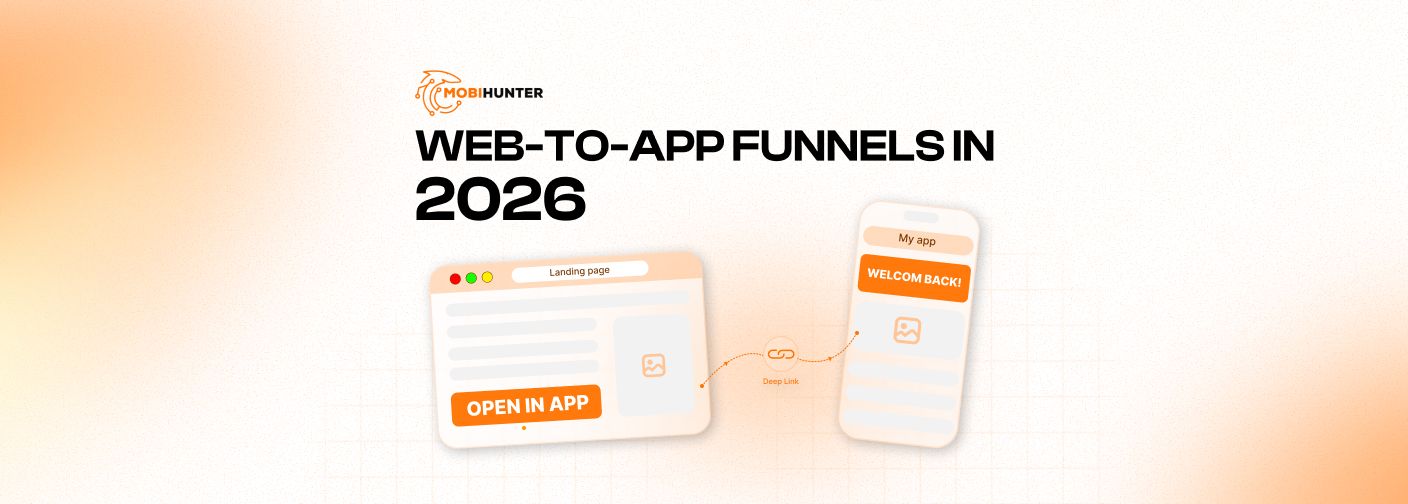
Instead of sending users from a paid ad directly to the App Store or Google Play listing, you send them to a landing page you control. That page does some or all of the onboarding work: it qualifies intent, personalizes the experience, sometimes collects payment, and then sends the user to install the app with a deep link that passes session data into the first open.
The user still downloads from the store. The difference is everything that happens before the install is on your infrastructure, not Apple's or Google's.
There are three main structures we use depending on the app category and goal.
1. The first is the quiz or survey funnel. The user lands on a page, answers 4 to 8 questions about themselves or their goals, sees a personalized result screen, and is then directed to install. This works exceptionally well for health, fitness, and productivity apps where the personalization angle drives both conversion and downstream retention.
2. The second is the onboarding-first funnel. The user goes through a simplified version of the in-app onboarding on the web page before installing. By the time they hit the store, they already understand the product value. This approach is particularly strong for apps with complex mechanics or a steep learning curve.
3. The third is the web paywall funnel. The user pays on a web checkout page before they install the app. They download the app and their subscription is waiting for them. This structure requires the most technical setup, but it unlocks the biggest financial advantage, which we will cover below.
Why the Economics Make Sense in 2026
App stores take between 15 and 30 percent of every in-app purchase. Web payment processors charge 2 to 5 percent. If your app does any volume of subscription revenue, that gap compounds into a significant number over the course of a year.
There is also a cash flow difference that matters when you are reinvesting into paid UA. App store payouts can take up to 60 days. Web payment processors typically pay out within 1 to 2 days. For teams scaling aggressively on Meta or TikTok, that payout cycle difference is the difference between reinvesting immediately and waiting two months to see if the unit economics held.
On the attribution side, a web landing page gives you full first-party data before the user ever reaches the store. You know which ad creative they came from, which landing page variant they saw, how long they spent on the page, whether they completed the quiz, and at what point they dropped. That data does not disappear behind SKAN or ATT. It lives in your own analytics and feeds directly into your MMP when the deep link fires on install.
Deep-linked journeys nearly double conversion rates compared to standard paid media flows, according to AppsFlyer data from 2024 to 2025. The session continuity matters. A user who goes from a personalized ad to a personalized landing page to a personalized in-app first session converts and retains at a meaningfully higher rate than a user who goes from an ad to a generic store listing.
Conversion Benchmarks by Vertical (May 2026)
These are directional ranges based on what we see across client accounts and published industry data. Your numbers will vary depending on creative quality, landing page design, and how well your audience targeting is tuned.
Subscription apps (health, productivity, dating): Landing page to install rates typically fall between 35 and 55 percent for quiz-style funnels. Web paywall completion rates, where the user purchases before downloading, range from 12 to 22 percent depending on the category and price point.
Fintech apps: Landing page to install is typically lower, in the 25 to 40 percent range, because the intent qualification is more deliberate. But the users who do install convert to activated accounts at a much higher rate than store-direct traffic.
Mobile games (casual and mid-core): Web-to-app is less common here and the economics are trickier because game revenue is often driven by in-app purchases that are harder to front-load. Some teams use web pages for registration or account creation as a soft commitment mechanism before install. We see this working well for mid-core titles where guild sign-up or community membership is a meaningful hook.
Utility and productivity apps: Solid category for web-to-app. Free trial framing on a landing page tends to outperform store-direct by 20 to 35 percent in our tests.
How to Set Up Attribution Correctly
This is where most teams stumble. The web page and the app are two separate environments, and stitching them together cleanly requires careful MMP configuration.
The core mechanism is a deep link with appended parameters that persist through the install. When the user taps the store button on your landing page, you append their session ID, the campaign data, and any personalization parameters to the deep link. After they install and open the app, the deep link fires and the MMP matches the web session to the app install.
With AppsFlyer, this is handled through their OneLink product. With Adjust, it is their deep link setup combined with web attribution. Branch has been a common choice for teams running complex web-to-app flows because their link infrastructure handles cross-environment continuity well.
A few things to get right before you launch. First, make sure your MMP is set up to receive and log the web touch as a separate touchpoint, not just the install. You want visibility into the full funnel, not just the last click. Second, test your deep link flow on both iOS and Android across multiple OS versions. The number of times a deep link works in staging and fails in production is higher than any of us would like. Third, align your UTM parameters and MMP campaign naming conventions before you start spending. Retroactively cleaning up attribution data is painful.
Landing Page Design: What Actually Converts
We have run enough web-to-app tests to have strong opinions here.
The page needs to communicate value in the first five seconds. That means the headline directly addresses the problem the user came from the ad thinking about. If the ad was about falling asleep faster, the headline talks about sleep, not your app's feature list.
Social proof should be early, not buried. Reviews, download counts, and editorial recognition (App of the Day, Editor's Choice) belong near the top of the page, not at the bottom where users who have already bounced cannot see them.
The call to action should match where the user is in their decision. If you are running a quiz funnel, the CTA at the end of the quiz is much higher intent than the CTA on page load. Do not put the same button everywhere.
Page speed is not optional. Every second of load time is conversion bleed, and it is especially punishing on mobile data connections. We target sub-two-second load times on 4G for all web-to-app landing pages.
When Web-to-App Is Not the Right Choice
We want to be honest about this. Web-to-app is not universally better. There are situations where it adds complexity without adding proportional return.
For apps with very high organic install rates, the incremental lift from a web funnel may not justify the build and maintenance cost. For hyper-casual games where the core loop is the sell, sending users through a five-screen quiz before they get to play creates friction that kills conversion. For teams without engineering resources to maintain deep link infrastructure, a poorly implemented web-to-app funnel performs worse than a well-optimized store listing.
The right question is not "should we use web-to-app" but "where in our current funnel is the biggest drop-off, and would a web intermediary fix it?" If the answer is at the store page because users are not converting from your listing, fix the store page first. If the answer is at the post-install onboarding step because users install but do not activate, a web-to-app funnel with pre-install qualification is a strong lever.
A Practical Launch Checklist
Before you go live with a web-to-app funnel, run through these.
MMP deep link configuration is tested on both platforms. UTM parameters are consistent from ad to landing page to MMP. Web analytics (GA4 or equivalent) is firing on all landing page events. Your landing page has a fallback path in case the deep link fails. Payment flow (if running a web paywall) has been tested across card types and devices. Legal has reviewed any claims made on the landing page, especially for health and fintech apps.
The Bigger Picture
Web-to-app funnels are not a shortcut to better performance. They are a structural improvement to how you move users through the acquisition journey. The teams getting the most out of them in 2026 are the ones treating the web landing page as a genuine product experience, not a placeholder between the ad and the store.
If you want to explore whether a web-to-app setup makes sense for your specific app and acquisition stack, our user acquisition team has run these builds across fintech, subscription, and gaming verticals. Get in touch with Mobihunter and we can walk you through what the setup would look like for your product.